
Privacy by Design: Why the Next Generation of Smart Devices May Need to Disconnect
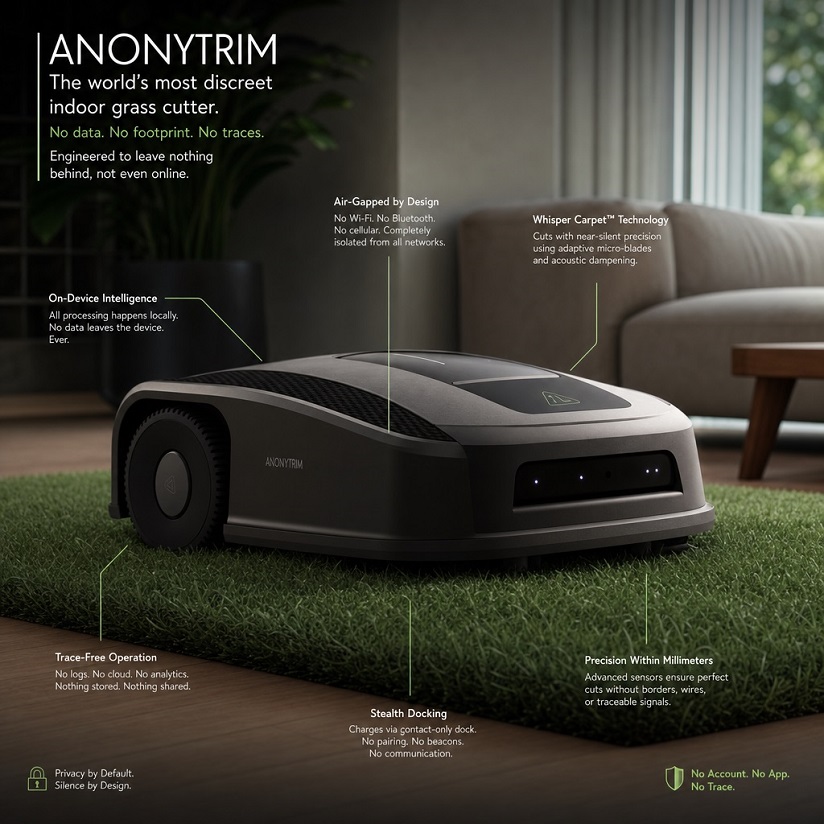
Concept illustration used for this article. The product depicted is a fictional concept intended to represent privacy-focused technology rather than a real commercial device.
For years, consumer technology has followed a predictable path: more connectivity, more cloud services, and more data collection. From smart speakers and security cameras to robotic vacuum cleaners and wearable devices, modern products often rely on constant internet access to deliver their full range of features.
But what if the future of smart technology isn't about being more connected? What if it's about knowing when not to connect?
The concept illustrated above explores that idea through a fictional autonomous indoor grass cutter called ANONYTRIM. While the device itself isn't a real product, the design highlights several emerging trends that are already influencing how engineers think about privacy, artificial intelligence, and edge computing.
The Rise of On-Device Intelligence
One of the most significant shifts in AI is moving computation away from distant cloud servers and onto the device itself.
Instead of sending user data across the internet for processing, modern processors can now perform tasks locally. Speech recognition, image analysis, and navigation algorithms increasingly run directly on smartphones, laptops, and embedded systems.
This approach offers several benefits:
-
Faster response times
-
Reduced dependence on internet connectivity
-
Improved privacy
-
Lower bandwidth usage
-
Greater reliability
Rather than asking, "What can the cloud do?" many developers are beginning to ask, "What can the device do on its own?"
Privacy Is Becoming a Product Feature
Consumers have grown more aware of how much information connected devices can collect.
Usage statistics, location history, voice recordings, diagnostic logs, and behavioral analytics have become common parts of the connected ecosystem. While this data can improve products and services, it also raises important questions about ownership, consent, and security.
Privacy-first design attempts to reverse that model by collecting only what is genuinely necessary—or, in some cases, collecting nothing at all.
Concepts like the one shown emphasize ideas such as:
-
Local data processing
-
Minimal data retention
-
No continuous cloud synchronization
-
Reduced digital footprints
-
User control over information
These principles are increasingly reflected in both consumer expectations and technology regulations around the world.
Air-Gapped Devices: Extreme, but Effective
The illustration also references an air-gapped design, meaning the device has no Wi-Fi, Bluetooth, or cellular connectivity.
In everyday consumer electronics, this level of isolation is uncommon. However, air-gapped systems are widely used in environments where security is critical, including industrial control systems, defense applications, research laboratories, and highly sensitive infrastructure.
Although most home devices benefit from connectivity, the concept raises an interesting question:
Does every smart device actually need internet access?
For certain specialized tools, the answer may be no.
Edge Computing Changes the Equation
Advances in semiconductor technology have dramatically increased what compact devices can accomplish independently.
Today's processors can execute sophisticated AI models without transmitting raw user data to external servers. This shift—known as edge computing—enables applications such as:
-
Real-time object recognition
-
Voice assistants that function offline
-
Autonomous navigation
-
Predictive maintenance
-
Intelligent robotics
As hardware continues to improve, fully autonomous offline systems become increasingly practical.
Security Through Simplicity
Every connected feature introduces another potential attack surface.
Software updates, cloud APIs, wireless protocols, and remote management tools all improve functionality, but they also create opportunities for vulnerabilities.
A simpler device often has fewer points of failure.
While complete isolation isn't practical for every product, minimizing unnecessary connectivity can reduce security risks while improving reliability.
The Future May Be Selectively Connected
Connectivity isn't going away—and it shouldn't. Cloud services remain invaluable for collaboration, backups, and large-scale AI workloads.
However, the next wave of consumer technology may become more selective about when and how devices communicate.
Imagine products that:
-
Work fully offline by default
-
Require explicit permission before sharing data
-
Process sensitive information locally
-
Connect only when users choose
-
Remain functional even without internet access
Rather than treating privacy as an optional setting hidden deep inside a menu, future devices could make it their default operating principle.
Conclusion
The fictional ANONYTRIM concept represents more than an unusual robotic lawn device. It illustrates a broader shift in technology philosophy: intelligence doesn't always require constant connectivity.
As AI becomes more capable and hardware grows more powerful, the industry's focus may gradually move from collecting more data to using data more responsibly. The smartest devices of tomorrow may not be those that know everything about us—they may be the ones that know just enough to do their job, and nothing more.