The Owlfly’s Hidden Mastery: How One of Nature’s Most Overlooked Insects Became an Aerial Specialist
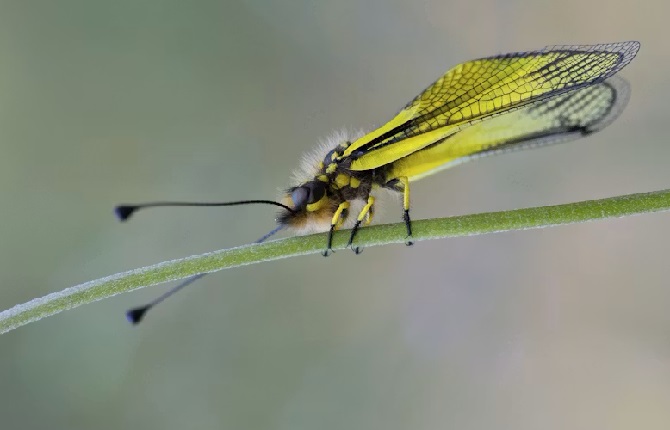
At first glance, it seems like a contradiction brought to life. Its wings evoke a butterfly drifting over summer meadows, its body recalls the streamlined form of a dragonfly, and its oversized eyes give it an almost curious expression. Yet the insect resting quietly on a single blade of grass belongs to neither of those familiar groups. It is an owlfly—a rarely noticed predator whose elegance conceals millions of years of evolutionary refinement.
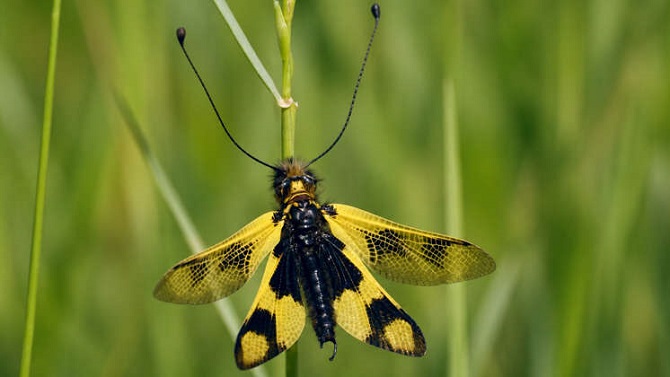
On warm afternoons across Europe's flower-rich grasslands and Mediterranean landscapes, owlflies spend long periods perched motionless above the vegetation. To many walkers, they are invisible. Their stillness blends perfectly into the surrounding meadow until sudden movement transforms the illusion. Without warning, the insect launches into the air, intercepts a passing fly with remarkable precision, and returns to its perch almost as quickly as it departed.
Moments like these reveal an extraordinary truth about the natural world: some of its most sophisticated hunters remain among its least recognized.
Although owlflies rarely attract the same attention as butterflies, dragonflies, or bees, they represent one of the most remarkable evolutionary branches within the insect kingdom. Their unusual appearance, exceptional eyesight, agile flight, and important ecological role have fascinated entomologists for decades, yet they remain unfamiliar to much of the public.
Increasingly, high-resolution macro photography is changing that. Images capable of revealing every vein across an owlfly's wings and every segment of its distinctive antennae are introducing audiences to a species that has quietly flourished in open landscapes for millions of years.
Neither Dragonfly nor Butterfly
One reason owlflies attract immediate curiosity is that they appear difficult to classify.
Their long, slender abdomen resembles that of a dragonfly.
Their broad, colorful wings often resemble butterflies.
Their slow perching behavior can resemble damselflies.
Yet none of these comparisons tells the full story.
Owlflies belong to the insect order Neuroptera, commonly known as the net-winged insects. This ancient lineage also includes lacewings, mantidflies, and antlions.
Among their closest relatives are antlions, famous for the funnel-shaped traps constructed by their larvae in sandy soil.
Adult owlflies, however, pursue a very different lifestyle.
Rather than waiting for prey, they actively hunt while flying, combining outstanding visual processing with exceptional aerial maneuverability.
This evolutionary path has produced insects that occupy an ecological niche unlike almost any other.
The Signature Features of Libelloides
The insect described is likely a member of the genus Libelloides, one of the most recognizable owlfly groups found throughout parts of southern and central Europe.
Several characteristics immediately distinguish these insects from other flying species.
The first is their extraordinary antennae.
Unlike dragonflies, whose antennae remain short and inconspicuous, owlflies possess remarkably elongated antennae ending in rounded clubs. These club-shaped tips function as important sensory organs, helping the insect detect its surroundings while contributing to its unmistakable appearance.
Equally striking are the wings.
Many Libelloides species display bold combinations of bright yellow, black, brown, and transparent sections arranged in intricate patterns.
These contrasting markings serve several possible purposes.
They may help individuals recognize members of their own species during mating.
They may confuse predators by breaking up the insect's outline.
They may even contribute to thermoregulation by influencing how sunlight is absorbed.
Scientists continue investigating the precise evolutionary advantages of these remarkable wing patterns.
Eyes Designed for Precision
Perhaps the owlfly's greatest hunting advantage lies in its vision.
Like dragonflies, owlflies possess enormous compound eyes occupying much of the head.
Each eye contains thousands of individual visual units known as ommatidia.
Together, these tiny lenses create a wide field of view capable of detecting even subtle movement.
For aerial predators, rapid visual processing is essential.
A small fly passing overhead presents only a fraction of a second for interception.
The owlfly's nervous system processes this information with remarkable speed, allowing it to calculate pursuit trajectories while already in flight.
The result appears effortless.
Yet behind every successful capture lies an extraordinary combination of biological engineering, neural processing, and aerodynamic control.
Masters of the Sunny Meadow
Unlike many insects that remain active throughout the day regardless of conditions, owlflies display distinct preferences.
Warm sunshine is essential.
These insects thrive in open grasslands, dry meadows, rocky slopes, and flower-rich habitats where abundant flying insects provide reliable food.
They often perch near the tips of grasses or flowering stems, selecting elevated positions that maximize visibility.
From these natural observation towers, they monitor the surrounding airspace.
Unlike spiders that rely on webs or ambush predators concealed beneath leaves, owlflies hunt actively through repeated short flights.
A passing insect triggers immediate action.
The owlfly launches.
Intercepts.
Returns.
Then waits once more.
This patient hunting strategy minimizes unnecessary energy expenditure while maximizing opportunities presented by busy summer meadows.
A Diet Built Around Flight
Adult owlflies feed almost exclusively on small flying insects.
Their prey includes:
-
Tiny flies
-
Mosquitoes
-
Midges
-
Small moths
-
Aphids
-
Leafhoppers
-
Other soft-bodied airborne insects
Although individually insignificant, these prey species form an important part of meadow ecosystems.
By regulating populations of numerous small insects, owlflies contribute to maintaining ecological balance within grassland communities.
Predators of this size rarely eliminate prey populations.
Instead, they help prevent excessive population growth that might otherwise disrupt local biodiversity.
Every successful hunt reinforces an ecological relationship refined over millions of years.
The Remarkable Wings
One of the most captivating aspects of macro photography is its ability to reveal structures invisible to the naked eye.
An owlfly's wings illustrate this perfectly.
At ordinary viewing distances, they appear smooth and delicate.
Magnification tells another story.
Each wing consists of an intricate network of intersecting veins forming hundreds of tiny cells.
These net-like patterns give the insect order Neuroptera its name.
Far from decorative, these veins provide both strength and flexibility.
They distribute aerodynamic forces across the wing while allowing subtle adjustments during flight.
Engineers studying lightweight structural design have long found inspiration in similar natural architectures.
Nature repeatedly demonstrates how complexity can emerge without unnecessary weight.
The owlfly's wings represent one of countless examples.
From Predator to Parent
The adult stage receives most public attention, but the owlfly's life begins in a very different form.
After mating, females deposit eggs on vegetation.
Emerging larvae bear little resemblance to the graceful adults they will become.
Like their antlion relatives, owlfly larvae are predatory from an early age.
Armed with elongated jaws capable of piercing prey, they hunt other small invertebrates among vegetation or leaf litter.
Growth occurs gradually through multiple molts.
Only after completing this developmental process does metamorphosis transform the larva into the winged adult familiar to photographers.
Unlike butterflies, whose complete metamorphosis includes a pupal stage enclosed within a chrysalis, Neuropteran development follows its own evolutionary pathway while still producing dramatic changes between juvenile and adult life.
Why Macro Photography Matters
For decades, insects like owlflies remained overlooked largely because appreciating their complexity required magnification unavailable to most observers.
Today's macro photography has transformed public understanding.
High-resolution images reveal:
-
Individual wing veins.
-
Compound eye structure.
-
Fine body hairs.
-
Antennal segments.
-
Color patterns invisible to casual observation.
Beyond aesthetics, these photographs contribute to science.
Researchers increasingly rely on high-quality citizen photography to document species distributions, seasonal emergence dates, and habitat use.
In an era of widespread smartphone photography combined with dedicated macro equipment, amateur naturalists increasingly contribute valuable biodiversity records supporting professional research.
Every carefully documented observation expands scientific knowledge.
A Species Facing Quiet Challenges
Although owlflies continue inhabiting suitable landscapes across parts of Europe, many populations depend upon increasingly fragmented habitats.
Traditional flower-rich meadows have declined significantly across much of the continent.
Agricultural intensification.
Urban development.
Road construction.
Changes in grazing practices.
All reduce the availability of the open sunny habitats owlflies require.
Insect declines more broadly also present concern.
Because owlflies depend entirely upon abundant flying prey, reductions in insect diversity can ripple upward through food webs.
Conservation efforts increasingly focus on preserving native grasslands, reducing unnecessary pesticide use, and restoring habitat connectivity that allows insect populations to remain healthy.
Protecting charismatic mammals often captures public imagination.
Protecting insects may appear less glamorous.
Yet the ecological services provided by species like owlflies underpin the health of countless terrestrial ecosystems.
Evolution's Quiet Success Story
The owlfly illustrates an important lesson about evolution.
Success is not measured by fame.
It is measured by persistence.
Long before humans walked across European meadows, owlflies already occupied their ecological niche.
They survived climatic fluctuations, shifting landscapes, and changing biological communities by refining specialized hunting abilities suited perfectly to open grasslands.
Today, they continue performing those same ecological roles largely unnoticed.
Their presence signals healthy habitats rich in biodiversity.
Their disappearance would indicate broader ecological changes extending far beyond a single insect species.
More Than an Unusual Insect
A macro photograph of an owlfly resting on a blade of grass captures far more than visual beauty.
It records an ancient predator equipped with extraordinary sensory systems, aerodynamic precision, and evolutionary innovations unlike those of more familiar insects.
Its large compound eyes reveal constant awareness.
Its club-shaped antennae distinguish an evolutionary lineage stretching back millions of years.
Its intricately veined wings embody structural efficiency refined through natural selection.
And its quiet presence reminds us that some of nature's greatest achievements exist not among the largest or loudest creatures, but among those easily overlooked.
In every healthy meadow, thousands of interactions unfold beyond ordinary human perception. Tiny predators regulate insect populations. Pollinators connect flowering plants. Decomposers recycle nutrients back into the soil. Each organism contributes to an ecological network whose stability depends on diversity rather than dominance.
The owlfly is one small thread within that vast living tapestry.
By slowing down long enough to notice it—and by protecting the habitats where it thrives—we gain more than an appreciation for an unusual insect. We gain a deeper understanding of the intricate relationships that sustain life across even the quietest corners of the natural world.
Learn More
For readers interested in insects, biodiversity, and meadow conservation, these trusted resources provide additional information:
-
Natural History Museum (UK) – Insects: https://www.nhm.ac.uk/discover/insects.html
-
Xerces Society for Invertebrate Conservation: https://www.xerces.org/
-
IUCN Red List of Threatened Species: https://www.iucnredlist.org/
-
Encyclopaedia of Life (EOL): https://eol.org/
-
GBIF – Global Biodiversity Information Facility: https://www.gbif.org/