The Silent Intelligence of the Red Fox: A Master of the Forest's Hidden Economy
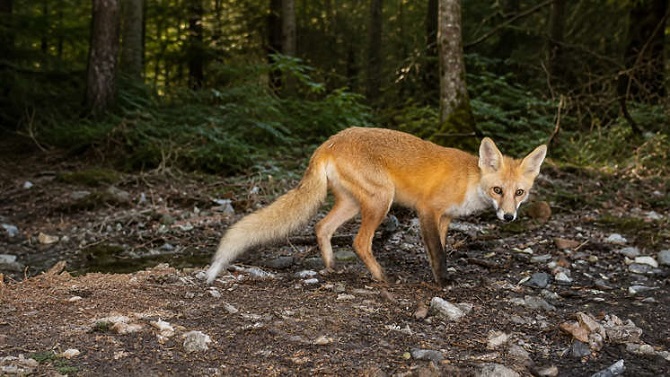
The forest appears still at first glance. Wind stirs the canopy, leaves shift across the trail, and distant birds exchange calls from unseen branches. Then movement breaks the illusion. A red fox emerges from the shadows, placing each paw with deliberate precision as though the woodland itself has taught the art of silence. It pauses for a moment, ears turning independently, nose sampling invisible scents carried by the breeze. Satisfied that the path ahead presents neither danger nor opportunity worth immediate attention, it continues its quiet patrol.

To many people, the sight lasts only seconds. Yet behind that brief encounter lies the story of one of the world's most adaptable wild predators—a species that has survived ice ages, expanding cities, agricultural revolutions, and changing climates by mastering a skill more valuable than strength alone: adaptability.
The red fox (Vulpes vulpes) is neither the largest hunter in the forest nor the fastest. It succeeds because it learns, observes, and adjusts. Every silent step along a woodland trail reflects thousands of years of evolution shaped by changing landscapes and unpredictable environments.
For wildlife photographers and nature enthusiasts, few moments are as rewarding as witnessing a red fox behaving naturally. Increasingly, hidden trail cameras are making those encounters possible without disrupting the animal's daily routine, offering remarkable insights into a creature that has long occupied both scientific research and human imagination.
A Predator Built for Flexibility
Unlike specialists that depend on a narrow range of prey or habitat, the red fox has embraced versatility as its greatest survival strategy.
Found across much of North America, Europe, Asia, and parts of North Africa, the species has also established populations in Australia after historical introductions. From snowy boreal forests and rolling farmland to mountain valleys and suburban neighborhoods, few wild mammals demonstrate such ecological flexibility.
This success begins with the fox's physical design.
Weighing between 3 and 14 kilograms (7–31 pounds), most adult red foxes possess a lean frame that allows them to move efficiently through dense vegetation. Their rust-colored coat provides camouflage among autumn leaves and woodland undergrowth, while black legs and white-tipped tails make each individual instantly recognizable to experienced observers.
The fox's bushy tail—often called a "brush"—serves several purposes. It provides balance during rapid turns, acts as insulation during cold weather, and even functions as a blanket when the animal curls up to rest during winter nights.
Yet the fox's greatest tools cannot be seen so easily.
Its hearing is among the finest in the mammalian world.
Scientists have found that red foxes can detect tiny sounds produced by rodents moving beneath snow or layers of fallen leaves. Combined with an acute sense of smell, these remarkable sensory abilities allow the fox to locate prey hidden completely out of sight.
The Art of Moving Unnoticed
Watching a red fox travel through the forest often resembles observing an experienced tracker.
Rather than rushing through the landscape, it advances cautiously, pausing frequently to gather information.
Every stop has purpose.
The fox listens.
It smells.
It watches.
To human eyes, the forest may appear unchanged between those pauses. To the fox, however, every breeze carries new information.
The scent of a rabbit may drift from nearby shrubs.
Fresh tracks may reveal another predator's recent passage.
Bird alarm calls may indicate movement elsewhere in the forest.
This constant flow of environmental information shapes every decision the fox makes.
Unlike predators that rely on explosive speed over long distances, red foxes often succeed because they know exactly when patience becomes more valuable than pursuit.
A Diet as Diverse as the Landscape
One reason the red fox thrives in so many environments is its willingness to eat almost anything suitable.
Although commonly viewed as a carnivore, the species is better described as an opportunistic omnivore.
Its menu changes with the seasons.
During spring and summer, rodents such as voles and mice provide valuable protein.
Rabbits become important prey where available.
Ground-nesting birds and their eggs occasionally supplement the diet.
Large insects—including beetles and grasshoppers—offer easy meals during warmer months.
As autumn arrives, berries, apples, wild fruits, and nuts become increasingly valuable food sources.
In winter, when prey becomes scarce, foxes may scavenge carcasses left by larger predators or feed on whatever natural resources remain available.
This dietary flexibility explains why fox populations often remain stable despite seasonal fluctuations that challenge more specialized predators.
The Famous Fox Leap
One of the species' most recognizable hunting behaviors is known informally as the "mousing pounce."
After detecting movement beneath snow or leaf litter, the fox freezes.
Its ears rotate precisely toward the source.
Then, with remarkable accuracy, it launches high into the air before diving headfirst into the ground.
The maneuver appears almost playful.
In reality, it represents extraordinary precision.
Recent research suggests foxes may even use Earth's magnetic field as an additional navigational reference when judging the location of hidden prey, although scientists continue to investigate exactly how this ability functions.
Whether guided by sound, smell, magnetic cues, or a combination of sensory information, the result is often astonishingly successful.
Intelligence Beyond Instinct
The phrase "cunning as a fox" appears in countless cultures.
While folklore often exaggerates animal intelligence, modern research confirms that red foxes possess impressive cognitive abilities.
Foxes quickly learn the geography of their territory.
They remember reliable food sources.
They adjust hunting techniques depending on weather conditions.
Individuals living near human settlements frequently alter their activity patterns to avoid busy periods while taking advantage of quieter hours.
This behavioral flexibility demonstrates learning rather than simple instinct.
Like many highly adaptable mammals, foxes continually modify their routines based on experience.
Such intelligence has enabled them to survive environmental changes that have challenged many less flexible species.
Family Life Hidden Beneath the Forest
Despite their solitary reputation, foxes devote considerable effort to raising young.
Breeding typically occurs during winter.
Following a gestation period of approximately 52 days, the female gives birth inside a sheltered underground den.
Litters commonly contain four to six kits, although numbers vary depending on food availability.
During the first weeks of life, the mother remains with her offspring while the male frequently provides food.
As the kits grow, both parents contribute to their development.
Young foxes spend hours wrestling, chasing siblings, and exploring the area surrounding the den.
These playful interactions strengthen muscles, improve coordination, and teach hunting behaviors essential for survival.
By late summer, many juveniles begin establishing territories of their own.
Why Wildlife Cameras Matter
For generations, much of fox behavior remained hidden.
The species is primarily active during twilight and nighttime hours, making direct observation difficult.
Today's motion-activated trail cameras have transformed wildlife research.
Placed carefully along forest paths and game trails, these cameras capture animals without introducing the constant presence of humans.
Researchers now observe behaviors once rarely documented:
-
Territorial scent marking.
-
Family interactions around dens.
-
Seasonal changes in activity.
-
Hunting techniques.
-
Encounters with other wildlife.
Perhaps equally important, these recordings foster public appreciation for species many people may never encounter directly.
Rather than viewing foxes solely through folklore or occasional roadside sightings, audiences gain access to authentic moments of wild behavior unfolding naturally.
Living Alongside Humans
Few wild predators have adapted to human expansion as successfully as the red fox.
Across Europe, North America, and parts of Asia, foxes increasingly inhabit suburban parks, golf courses, agricultural fields, and even city neighborhoods.
Urban foxes face unique challenges.
Road traffic presents constant danger.
Artificial lighting alters natural behavior.
Domestic dogs occasionally create territorial conflicts.
Yet cities also provide opportunities.
Gardens support rodents.
Parks offer shelter.
Fruit trees provide seasonal food.
This ability to navigate both wilderness and developed landscapes has made the red fox one of the planet's most widespread carnivorous mammals.
The Health of Forest Ecosystems
Although small compared with wolves or large cats, foxes play an important ecological role.
By controlling rodent populations, they help maintain balance within forest ecosystems.
Fewer rodents may reduce crop damage in nearby agricultural areas while limiting the spread of certain diseases carried by small mammals.
Foxes also contribute to seed dispersal.
After consuming berries and fruits, they deposit seeds across their territories, assisting the regeneration of native vegetation.
Even scavenging performs a valuable ecological function by recycling nutrients that would otherwise remain locked within animal carcasses.
Each activity contributes quietly to the health of the broader ecosystem.
Challenges Facing Red Foxes
Despite their adaptability, foxes remain vulnerable to human-driven environmental changes.
Habitat fragmentation divides once-connected forests into isolated patches.
Heavy traffic increases mortality near expanding urban areas.
Rodenticides and other poisons may indirectly affect foxes through contaminated prey.
Climate change also influences prey availability and seasonal breeding patterns in some regions.
Conservation efforts increasingly emphasize maintaining connected habitats, protecting biodiversity, and reducing unnecessary chemical use to preserve healthy ecosystems capable of supporting both predators and prey.
The red fox's resilience should not be mistaken for invulnerability.
Healthy forests remain essential to its long-term success.
A Rare Window Into the Wild
A trail camera recording of a fox walking silently along a forest path may appear simple.
Yet each frame contains layers of ecological significance.
The cautious pause before moving forward demonstrates constant risk assessment.
The careful positioning of every foot reflects thousands of successful hunting generations.
The alert ears reveal a world of sound beyond human perception.
And the decision to continue searching speaks to an animal whose survival depends not on brute force, but on observation, patience, and flexibility.
Such footage reminds us that forests remain active even when they appear empty.
Long after hikers return home and daylight fades beneath the trees, countless animals continue lives shaped by routines invisible to most people.
The red fox is among the finest ambassadors of that hidden world.
Its quiet passage through the woodland illustrates that nature's greatest stories rarely announce themselves with spectacle. More often, they unfold in silence—one careful step, one attentive pause, and one successful hunt at a time.
In protecting forests, we preserve more than landscapes. We safeguard intricate relationships between predators and prey, plants and animals, seasons and survival. Every healthy woodland provides space for creatures like the red fox to continue performing ecological roles refined over millennia, sustaining the delicate balance upon which entire ecosystems depend.
Learn More
For readers interested in wildlife ecology, fox behavior, and forest conservation, these authoritative resources offer further information:
-
Smithsonian's National Zoo & Conservation Biology Institute (Red Fox): https://nationalzoo.si.edu/animals/red-fox
-
National Geographic – Animals: https://www.nationalgeographic.com/animals
-
The Wildlife Trusts (UK): https://www.wildlifetrusts.org/
-
International Union for Conservation of Nature (IUCN Red List): https://www.iucnredlist.org/
-
Animal Diversity Web – Red Fox: https://animaldiversity.org/accounts/Vulpes_vulpes/